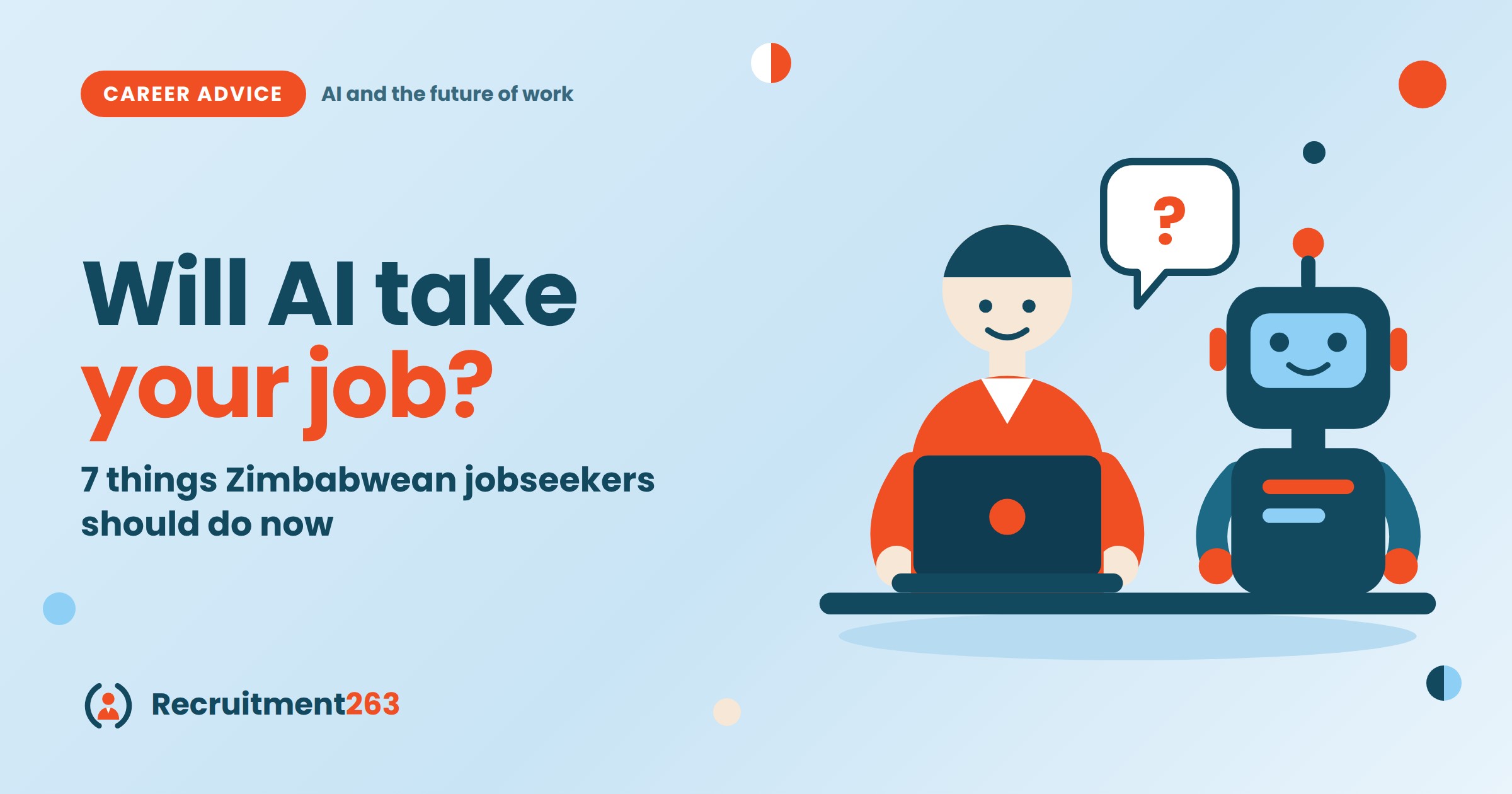
Will AI Take Your Job? 7 Things Zimbabwean Jobseekers Should Do Now
Nobody can predict the AI economy — but you can stop preparing for yesterday's job market. Seven practical moves for Zimbabwean jobseekers in 2026.
“Will AI take my job?”
If you are looking for work in Zimbabwe in 2026, that is a reasonable question to be asking. You may be a graduate sending applications and wondering whether the career you are preparing for will still look the same in five years. You may already be employed and watching your organisation introduce AI tools that can draft emails, summarise documents, analyse information and produce reports in a fraction of the time. Or perhaps you are simply trying to decide which skill is worth learning next.
The difficult answer is that nobody knows exactly what the next few years will look like. But we are starting to get better information about the possibilities.
In September 2026, Anthropic’s Economics team released its AI economic-futures model, an interactive model exploring how different levels of AI capability and adoption could affect jobs, wages, unemployment and economic growth in the United States by 2030. The model presents several possible futures, ranging from a relatively modest economic impact to an extreme scenario in which AI becomes capable of performing nearly all knowledge-work tasks autonomously.
That does not mean Zimbabwe will follow the same path. The model is designed around the US economy, and Anthropic itself describes it as a simplification of a much more complicated reality.
Still, the exercise raises a question that matters here too: if the tasks employers pay people to perform are changing, are your skills changing with them?
You do not need to predict exactly what the AI economy will look like in 2030. You do need to make sure that you are not preparing for yesterday’s job market. Here are seven things you can do now.
1. Stop asking “Will AI take my job?” Ask which parts of your job it can do
Take the job description for the position you want and look at what the employer is actually asking you to do. Perhaps it includes preparing reports, responding to emails, updating databases, analysing information, creating presentations or handling routine customer enquiries. Instead of treating the entire occupation as either “safe” or “at risk”, break it down into individual tasks and ask which ones software could already help someone perform.
That distinction matters because AI does not necessarily replace an entire job in one move. It can first change how the job is performed, reducing the time required for some tasks while increasing the value of others.
If you work in accounting, for example, routine data processing and parts of financial reporting may become easier to automate or accelerate. If you work in communications, AI can already help with research, summaries, first drafts and content variations. In customer service, routine enquiries can increasingly be handled through automated systems, while complicated complaints and relationship management still require human judgement.
The useful question, therefore, is not simply “Can AI do my job?” It is: “Which parts of my job are becoming easier to automate, and what can I become better at that technology cannot easily do?” That might mean developing stronger analytical skills, learning to manage technology, becoming better at dealing with clients or developing expertise that requires professional judgement.
Your job may change before it disappears. Prepare for the change.
2. Don’t throw away your degree. Make it more useful.
You spent years earning your qualification, so the answer to AI is not necessarily to abandon your profession and start again. A better strategy is to ask what you can add to what you already know.
A marketing graduate who understands AI-assisted content production, analytics and conversion optimisation has a different proposition from a marketing graduate who only knows how to write a traditional marketing plan. An accountant who can work with data-analysis tools is more versatile than one who only knows the processes they were taught at university. A communications professional who can use AI for research and production, while still understanding audiences, messaging and reputation, can potentially handle a much broader workflow.
The same principle applies across sectors. The strongest career move may not be a completely new qualification; it may be a second skill that makes your existing qualification more valuable.
So before you decide that your degree is becoming obsolete, ask: what technology is changing my profession, and what do I need to learn to work effectively alongside it? That could mean data analytics, digital marketing, AI tools, project management, automation, financial technology, digital health, agricultural technology or another skill relevant to your field.
The goal is not to become an AI expert simply for the sake of having “AI” on your CV. The goal is to become more useful because you understand both your profession and the technology changing it.
3. Don’t just learn AI. Use it to produce something.
There is a big difference between saying “I know ChatGPT” and being able to demonstrate how you have used AI to solve a real problem.
If you are job hunting, start with the jobs you are already applying for. Take a vacancy and analyse its requirements. Ask an AI tool to identify the skills that appear most important, compare those requirements with your CV and point out where your evidence is weak. Then verify its analysis yourself. You have now used AI for something that matters.
You can do the same in your profession. If you work in communications, use AI to organise research and produce a first draft of a press statement, then fact-check it, improve the argument and adapt it to the intended audience. If you work in finance, use it to help explore a dataset or explain a calculation, but verify the numbers yourself. If you work in administration, use it to structure a workflow, organise information or create a first version of a document.
The valuable skill is not simply generating an answer. It is knowing what to ask, what to verify, what to reject and how to improve the result. That is the difference between someone who has experimented with AI and someone who can actually use it at work.
4. Build proof that you can think, not just proof that you can complete tasks
Here is something worth doing with your CV. Look at each major responsibility under your previous jobs and ask whether it demonstrates a result, a decision or simply a task.
“Prepared monthly reports” tells an employer what you did. “Redesigned the monthly reporting process and reduced preparation time from five days to two” tells them considerably more. It shows that you identified a problem, changed something and achieved a result.
That distinction is becoming increasingly important as technology makes routine output easier to produce. Your CV should not simply prove that you were present at work. It should show what you improved, solved, created, managed or achieved.
Perhaps you reduced errors in a process. Perhaps you helped win a new client. Perhaps you increased engagement on a campaign. Perhaps you reorganised a system that was slowing your team down. Perhaps you identified a problem before it became expensive. Those examples demonstrate judgement, and judgement is difficult to communicate with a list of job titles and qualifications alone.
Start keeping a record of your best work. Every time you solve a problem or improve something, write down what happened, what you did and what changed afterwards. When you eventually update your CV, you will have evidence to work with rather than trying to remember your achievements from three years ago.
If you need help turning those achievements into a stronger application, Recruitment263 also provides CV-building resources and templates alongside its job listings.
5. Don’t wait until you’re unemployed to become employable somewhere else
Imagine that your employer tells you tomorrow that your position is being restructured. What happens next?
If your plan is to update your CV, start searching for courses and then begin applying for completely different jobs, you have already lost valuable time. Changing careers is rarely an overnight decision. You may need new skills, new qualifications, practical experience or a way to convince an employer that you can perform work you have never done before.
That is why your Plan B should not begin when Plan A ends. Choose one alternative career that interests you and investigate it properly. Look at the vacancies being advertised, identify the skills employers repeatedly ask for, find out which qualifications or certifications matter and work out what you could realistically learn over the next six months.
You do not necessarily have to leave your current job while doing this. The point is to create options before you need them.
And if you are currently unemployed, the same principle applies. Do not simply apply for every vacancy you see. Use the vacancies themselves as market research. Look for patterns in what employers are asking for and use those patterns to decide what you should learn next.
6. Think beyond your next salary
This is probably the least comfortable piece of advice in the article. Ask yourself: if my salary stopped tomorrow, what else would I have? For many workers, the honest answer is another job search.
There is nothing wrong with employment. A salary is still the main source of income for millions of people, and not everyone has the capital or circumstances to start a business or accumulate significant assets. But there is a difference between earning a salary and building economic security.
Anthropic’s more extreme AI scenario illustrates one possible future in which a greater share of economic gains flows to capital rather than labour. In that scenario, the model estimates labour receives 45.2% of GDP while capital receives 54.8%. Those figures are scenario outputs, not predictions of what will happen in Zimbabwe.
The broader point is worth thinking about. If you can gradually build something that you own — a small business, productive equipment, an investment, a digital product, agricultural activity or another income-producing asset — you are no longer relying entirely on your ability to exchange time for a salary.
You do not need to become an entrepreneur overnight, and you certainly should not quit a stable job because an article told you to. Start small. The objective is simply to avoid having one employer, one income stream and one skillset as your entire financial strategy.
7. Stop looking only for the jobs you already know
There is another trap that catches jobseekers: searching only for the job title they already understand. If you studied marketing, you search for “Marketing Officer”. If you worked in administration, you search for “Administrator”. If you have worked in customer service, you search for “Customer Service Representative”.
That makes sense, but it can also make your job search unnecessarily narrow. Instead, pay attention to what employers are beginning to ask for.
Look through current job listings on Recruitment263 and study the language employers are using. Which software keeps appearing? Which technical skills are repeatedly requested? Which roles are combining traditional functions with technology? Which positions did you not know existed a few years ago?
You may begin to notice roles such as data analyst, business intelligence analyst, CRM specialist, digital marketing specialist, customer success specialist or technology project coordinator.
The exact titles will change, but the principle remains the same: watch where the market is moving instead of waiting for the market to tell you what your career should be.
Try this every six months. Review around 50 vacancies in your field and make a list of the skills that appear repeatedly. Choose one that is relevant to your career, learn it properly, build something that demonstrates you can use it, and add the evidence to your CV. Then do it again. That is a much better long-term strategy than collecting qualifications without checking whether employers actually need the skills they represent.
So, what should you do this week?
You do not need to predict exactly what the economy will look like in 2030. You need to understand where your career is today, where employers appear to be moving and what you can realistically do to close the gap.
Start with one job you would genuinely like to get. Read the job description carefully. Make a list of the skills the employer wants, then divide them into three groups: skills you already have, skills that technology can help you perform and skills you need to develop.
Now choose one from the third group. Learn it. Practise it. Build something with it. Put evidence of it on your CV. Then apply for jobs that require it.
That is how you prepare for an uncertain labour market: not by trying to predict the future perfectly, but by becoming more adaptable before you need to be.
And if you are looking for your next opportunity, start by seeing what employers are hiring for now. Browse the latest jobs and create a free account to save vacancies, apply with your CV and receive job alerts. Recruitment263 lists opportunities across corporate, NGO, government and other sectors, including jobs, internships, volunteer roles, consultancies and tenders.
Source: Anthropic Economics team, September 2026. The scenario explorer models possible US economic outcomes; it is not a forecast for Zimbabwe.